

1. Introduction: The Digital Renaissance of Indian Manufacturing
The Indian textile and apparel sector stands at a critical juncture, poised between its historical legacy as a global manufacturing powerhouse and a future defined by digital agility and environmental accountability. At the heart of this transformation lies the Print-on-Demand model—a mechanism that is fundamentally reshaping how garments are conceived, produced, and consumed. No longer is the industry solely dependent on the forecast-based mass production that defined the 20th century; instead, we are witnessing the rise of a demand-driven ecosystem that prioritises sustainability, personalisation, and economic efficiency.
This report offers an exhaustive analysis of the Print-on-Demand landscape in India, projected to reach a valuation of over USD 5.4 billion by 2033. It explores the convergence of sustainable manufacturing practices—such as the use of sustainable t-shirts in India and eco-friendly fabric tees—with the logistical realities of a rapidly urbanising nation. We delve into the technical nuances of GSM cotton oversized tees, the economic imperatives of fast fashion vs sustainable models, and the strategic advantages of emerging industrial hubs in West Bengal. By synthesising data on consumer behaviour, government incentives, and fibre science, this document serves as a strategic roadmap for stakeholders navigating the complex terrain of the modern Indian fashion economy.
2. The Macro-Economic Landscape of Print-on-Demand in India
2.1 The Explosion of the Domestic Market
The global Print-on-Demand market has evolved from a niche service for customised gifting into a robust retail strategy for mainstream apparel brands. In India, this evolution is accelerating at a pace that outstrips many mature markets. According to comprehensive market analysis, the Print-on-Demand market in India was valued at approximately USD 695.8 million in 2024. However, the trajectory is exponential; the sector is expected to grow at a Compound Annual Growth Rate (CAGR) of 25.9% through 2033, reaching a projected revenue of USD 5,419.0 million.
This growth is not merely a statistical anomaly but a reflection of big structural changes in the Indian economy. The “Services” segment of the Print-on-Demand market—encompassing printing, fulfilment, and logistics—is identified as the fastest-growing vertical. This indicates a maturing ecosystem where the primary bottleneck has shifted from digital design creation to physical execution. As internet penetration deepens in Tier 2 and Tier 3 cities, the addressable market for customised and premium cotton tees in India expands significantly, driven by a young demographic that values individual expression over generic mass-market apparel.
2.2 Global Context and India’s Strategic Position
While North America currently dominates the global Print-on-Demand revenue share, accounting for 36.2% in 2024, the growth vector is unmistakably shifting towards the Asia Pacific. India is recognised as the fastest-growing regional market in this zone. This shift is propelled by the dual advantage of a massive domestic consumer base and a robust manufacturing infrastructure that allows for lower production costs compared to Western counterparts.
The “Software” segment, which includes the design platforms and order management systems that facilitate Print-on-Demand, currently generates the largest revenue share (85.3% in 2024). This highlights the technology-first nature of the industry. Platforms that seamlessly integrate with e-commerce storefronts like Shopify or WooCommerce allow entrepreneurs to launch brands with minimal capital, effectively democratising the fashion industry. This low entry barrier is crucial in a market like India, where entrepreneurship is surging but capital access remains a challenge for many.
2.3 The Consumer Shift: From Commodity to Narrative
The Indian consumer of 2025 is increasingly discerning, moving away from “fast fashion” commodities toward products that carry a narrative. This trend is exemplified by brands like Anyaah Clothing, which utilise Print-on-Demand to offer products with distinct emotional hooks. Garments with names like “Anxious but Aesthetic,” “Laziness is BFF,” or “Hardworking but Not-appreciated” resonate deeply with the psychographic realities of the modern Indian youth.
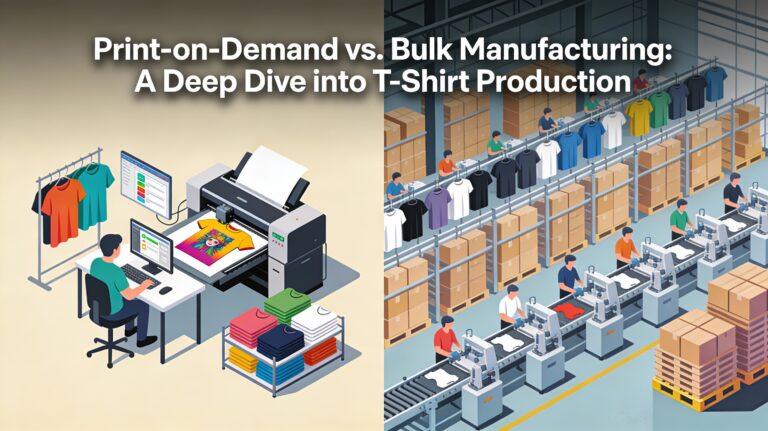
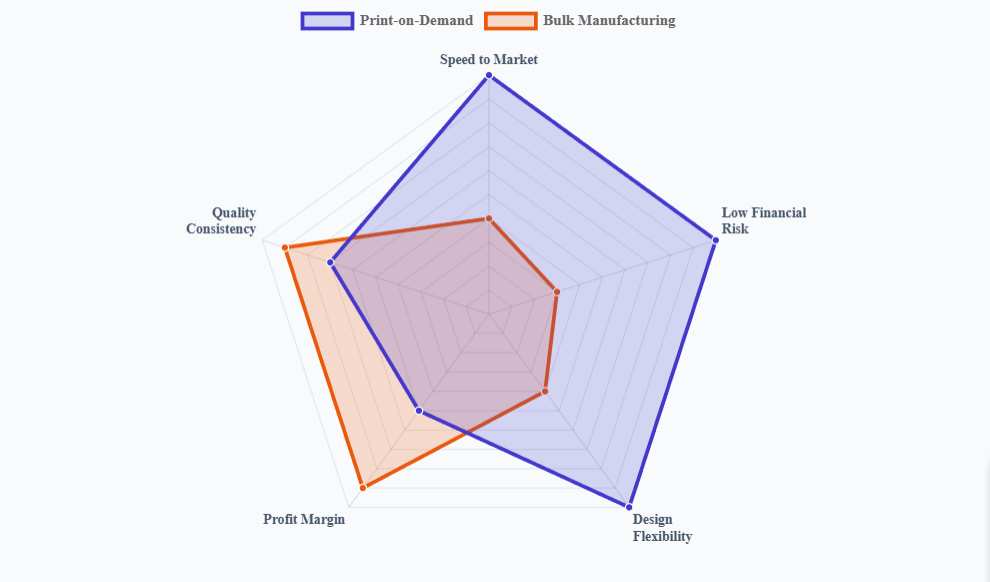
This “narrative retail” is intrinsically linked to the Print-on-Demand model. Because inventory risk is minimised, brands can experiment with micro-trends and niche messages without committing to thousands of units. If a specific slogan or design resonates, it can be scaled instantly; if it fails, the cost is negligible. This agility allows Print-on-Demand businesses to capture the zeitgeist in real-time, offering 100% cotton oversized t-shirts that serve not just as clothing, but as statements of identity.
3. The Sustainability Imperative: Fast Fashion vs. Sustainable Models
3.1 The Global Waste Crisis
To understand the necessity of Print-on-Demand, one must first confront the catastrophic environmental cost of the traditional fashion industry. The sector creates an estimated 92 million tonnes of textile waste annually. If current consumption patterns continue, this figure is projected to skyrocket to 134 million tonnes by 2030.
The traditional forecast-based manufacturing model relies on producing massive volumes to achieve economies of scale. However, this often leads to gross overproduction. It is estimated that between 80 and 100 billion garments are produced globally every year, a figure that far exceeds sustainable consumption levels. The result is a crisis of “Dead Stock”—inventory that is never sold.
The Fate of Unsold Clothing:
- Landfills: Approximately 57% of all discarded clothing ends up in landfills, where synthetic fibres like polyester can take up to 200 years to decompose.
- Incineration: About 25% of global clothing waste is incinerated, releasing carbon emissions and toxic micro-particles into the atmosphere.
- Recycling Failure: Despite the marketing claims of many brands, less than 1% of old clothing is actually recycled into new garments. Most “recycling” is actually down-cycling into insulation or industrial rags.
3.2 The Dead Stock Phenomenon and Inventory Risk
For new clothing brands, inventory mismanagement is the primary cause of business failure. In the high-stakes world of fashion retail, forecasting demand is notoriously difficult. A brand might order 1,000 units of a specific design, only to find that consumer tastes have shifted by the time the stock arrives. This unsold inventory, or “Dead Stock,” represents a massive financial drain. In the Indian online fashion market, return rates can be as high as 30%, further complicating inventory management.
The Print-on-Demand model offers a structural solution to this crisis. By decoupling production from forecasting, Print-on-Demand eliminates pre-consumer dead stock entirely. A garment is only manufactured after a customer has placed an order. There are no warehouses filled with unsold seasonal collections waiting to be dumped in a landfill. This “pull” manufacturing model is the single most effective sustainability strategy available to the modern fashion industry. It ensures that every resource used—every ounce of cotton, every drop of water—results in a product that is actually wanted and paid for.
3.3 The Rise of Organic and Eco-Friendly Fabrics
Sustainability in 2025 extends beyond waste reduction to the integrity of the raw materials themselves. Conventional cotton farming is one of the most chemical-intensive agricultural practices in the world. In contrast, sustainable t-shirts in India made from organic cotton have emerged as the gold standard for eco-conscious consumers.
GOTS Certification (Global Organic Textile Standard): This is the benchmark for true sustainability. GOTS certification ensures the organic status of textiles from the harvesting of raw materials through environmentally and socially responsible manufacturing to labelling. It is a holistic standard that covers the entire supply chain.
- Chemical Restrictions: GOTS prohibits the use of toxic heavy metals, formaldehyde, and GMO seeds.
- Social Compliance: It mandates fair labour practices, safe working conditions, and living wages for workers.
In India, manufacturers like Rajlakshmi Cotton Mills in Kolkata are pioneers in this space. They produce eco-friendly fabric tees using GOTS-certified organic cotton sourced from farmer cooperatives like Chetna Organic. By partnering with such certified manufacturers, Print-on-Demand brands can offer premium cotton tees in India that are not only high-quality but also ethically unimpeachable. This transparency is a critical competitive advantage in a market increasingly sceptical of “greenwashing.”
4. Technical Analysis: The Science of Premium Apparel
To command premium prices in the Print-on-Demand market (e.g., ₹999+ for a t-shirt), brands must deliver a product that is technically superior to the commoditised options found in street markets. This section provides a detailed technical analysis of the factors that define garment quality.
4.1 Fiber Science: Carded vs. Ring-Spun vs. Combed Cotton
The tactile quality and durability of a 100% cotton oversized t-shirt are determined primarily by the processing of the cotton fibre.
Carded (Open End) Cotton
This is the most basic form of cotton yarn. The fibres are cleaned and aligned but not combed to remove short fibres. The yarn is twisted loosely, resulting in a fabric that is rough, fuzzy, and uneven.
- Pros: Low cost.
- Cons: Low durability, prone to pilling, poor print surface.
- Verdict: Suitable only for low-cost promotional giveaways, not for a premium Print-on-Demand brand.
Ring-Spun Cotton
In this process, the cotton fibres are thinned, twisted, and spun to create a much finer, stronger, and softer rope of cotton fibres. The twisting process aligns the fibres, making the surface smoother and the yarn more durable.
- Pros: significantly softer and stronger than carded cotton.
- Cons: Slightly more expensive to produce.
- Verdict: The baseline for any respectable retail brand.
Combed Cotton
Combed cotton undergoes an additional step where fine brushes (combs) are used to pull out remaining impurities and short fibres. Approximately 15% of the volume is removed, leaving only long, straight fibres.
- Pros: Extremely soft (“buttery” feel), high durability, and a perfectly smooth surface.
- Cons: Higher cost due to material loss during combing.
- Verdict: The superior choice for Print-on-Demand. The removal of short fibres creates a flat canvas that is ideal for Direct-to-Garment (DTG) printing, ensuring that the ink bonds tightly and the print remains vibrant after multiple washes.
Table 1: Comparative Analysis of Cotton Yarn Types
Feature | Carded Cotton | Ring-Spun Cotton | Combed Cotton |
Texture | Rough, fuzzy | Soft, smooth | Very soft, lustrous |
Durability | Low (prone to holes) | High (strong twist) | Very High (no short fibres) |
Printability | Poor (fibrillation) | Good | Excellent (high detail) |
Cost Profile | Economy | Mid-Range | Premium |
Ideal Use | Election campaigns | Band merch | Sustainable t-shirts India |
4.2 GSM Analysis: The Weight Debate (180 vs. 240 GSM)
In the Indian textile context, GSM (Grams per Square Meter) is often used by consumers as a proxy for quality, though it technically measures fabric density and weight.
180 GSM (The Daily Driver)
A fabric weight of 180 GSM is considered the “sweet spot” for the Indian climate. It offers enough substance to be opaque and durable but is light enough to remain breathable in the heat of Delhi or Mumbai. It typically drapes naturally over the body.
240 GSM (The Structured Statement)
The rise of streetwear has popularised GSM cotton oversized tees in the 220-240 GSM range. This heavyweight fabric is thick, stiff, and structured. It does not cling to the body but rather holds its own shape, creating the “boxy” silhouette that is central to the oversized aesthetic.
- Technical Advantage: The density of 240 GSM fabric provides a superior platform for high-density prints and embroidery, as the fabric does not pucker under the weight of the ink or thread.
- Climate Consideration: While excellent for durability and style, 240 GSM can be too warm for peak Indian summer days. However, for “Gym Goers” or evening wear, it conveys a high-premium feel that justifies price points above ₹1,200.
4.3 Printing Technologies: DTG vs. Screen vs. DTF
The Print-on-Demand model relies heavily on the flexibility of printing technology.
- Direct-to-Garment (DTG): This acts like an inkjet printer for fabric. Water-based inks are sprayed directly onto the textile.
- Pros: Zero setup cost, unlimited colours, soft hand feel (especially on combed cotton). Ideal for one-off orders.
- Cons: High ink cost per unit; slower production speed.
- Direct-to-Film (DTF): An emerging powerhouse in the Print-on-Demand space. The design is printed on a PET film and transferred to the garment using heat and adhesive powder.
- Pros: Vibrant colours, works on almost any fabric (polyester, cotton, blends), cheaper than DTG for small batches.
- Cons: The print can feel “plastic-like” or heavy if the design is large (the “sweat patch” effect).
- Screen Printing: The traditional methodof pushing ink through a mesh screen.
- Pros: Extremely durable, cheapest for bulk.
- Cons: High setup costs (screens) make it unviable for single-unit Print-on-Demand orders. It requires a Minimum Order Quantity (MOQ) of usually 50+ pieces.
5. Strategic Geography: West Bengal as the New Manufacturing Hub
While Tirupur in Tamil Nadu has historically been the knitwear capital of India, West Bengal is rapidly emerging as a strategic alternative, particularly for sustainable and eco-friendly fabric tees manufacturing. This shift is driven by a combination of industrial infrastructure, government incentives, and logistical connectivity.
5.1 Industrial Corridors: Asansol and Durgapur
The Asansol-Durgapur industrial belt is a powerhouse of activity in Eastern India. Historically known for steel and coal, the region is diversifying into light manufacturing and textiles.
- Asansol: As the second-largest city in West Bengal, Asansol serves as a critical logistics node. It sits on the Grand Trunk Road (NH 19) and hosts major railway divisions, facilitating the movement of raw materials from the port at Haldia and finished goods to the consumption centres in the North and West.
- Durgapur: Known as the “Ruhr of India,” Durgapur’s planned infrastructure supports the heavy machinery required for setting up large-scale textile processing units. The availability of power and water—critical for dyeing units—is a significant advantage over water-stressed regions in other parts of India.
5.2 The West Bengal Textile Incentive Scheme (WBTIS)
To foster the growth of the textile sector, the state government has introduced the West Bengal Textile Incentive Scheme (WBTIS), valid until 2027. This policy framework offers substantial financial benefits that can drastically improve the Profit & Loss (P&L) statement of a new Print-on-Demand manufacturing unit.
Key Fiscal Incentives:
- State Capital Investment Subsidy:
- Units engaged in dyeing and processing, technical textiles, or non-woven fabric manufacturing are eligible for a 20% subsidy on the cost of plant and machinery.
- Spinning and knitting units can avail a 10% subsidy. This direct cash infusion lowers the break-even point for startups.
- Stamp Duty Waiver: The scheme offers a 100% reimbursement of stamp duty and registration fees paid for acquiring land or buildings for the project. In a capital-intensive industry, this waiver releases significant liquidity.
- Land Conversion Fee Waiver: The fees for converting land for industrial use are fully waived, simplifying the bureaucratic process of setting up a factory.
These incentives position West Bengal not just as a manufacturing base, but as a fiscally prudent choice for scaling a Print-on-Demand operation.
5.3 The Kolkata Sourcing Ecosystem
Kolkata acts as the trading nerve centre for the region. The city hosts a vast network of fabric wholesalers and intermediaries, clustered in areas like Burrabazar and facilitated by modern B2B platforms like Fabriclore.
- Access to Materials: Designers in Kolkata have immediate access to a wide range of textiles, from mill-dyed fabrics to Ready-for-Dyeing (RFD) blanks essential for Print-on-Demand.
- Sustainable Sourcing: The presence of major sustainable manufacturers like Rajlakshmi Cotton Mills within the city limits allows smaller brands to tap into world-class organic supply chains without the high logistics costs of transporting fabric from Southern India.
6. Logistics and Supply Chain: The Backbone of POD
In the Print-on-Demand model, the speed of delivery is as important as the quality of the product. The Indian consumer, spoiled by “10-minute grocery delivery,” expects their sustainable t-shirts to arrive rapidly.
6.1 Logistics Infrastructure: Rail vs. Road
For a manufacturing hub located in Asansol or Durgapur, the choice of transport mode for raw materials and bulk stock movement is critical.
- Rail Logistics: The Indian Railways network offers a sustainable and cost-effective solution for long-haul transport. Rail transport generates approximately 80% less carbon emissions compared to road transport, aligning perfectly with the ethos of an eco-friendly fabric tees brand. The Gati Shakti terminals in the Eastern Railway zone are modernising cargo handling, reducing transit times and improving connectivity between industrial hubs.
- Road Transport: While road transport offers last-mile flexibility, it is susceptible to congestion and price volatility due to fuel costs. However, local transport aggregators in Asansol, like Vahak, play a crucial role in connecting the factory gate to the railway siding or the courier hub.
Table 2: Comparative Logistics Analysis (Asansol Origin)
Destination | Mode | Est. Transit Time | Cost Efficiency | Sustainability |
Kolkata (Port/Hub) | Road | 1 Day | Medium | Low |
Kolkata (Port/Hub) | Rail | <1 Day | High | High |
Delhi (Consumer) | Rail | 2-3 Days | High | High |
Delhi (Consumer) | Air Express | 1 Day | Low (Expensive) | Very Low |
Mumbai (Consumer) | Rail | 3-4 Days | High | High |
6.2 Last-Mile Delivery Partners
For the final delivery to the customer, Print-on-Demand brands rely on specialised courier services.
- BlueDart: Known for its reliability and premium service. Its “Domestic Priority 10:30” and “12:00” services guarantee next-day delivery to major metros, making it the ideal partner for high-value orders where speed is a differentiator.
- DTDC: With a massive network reaching into the deepest rural pockets of India, DTDC is essential for brands targeting Tier 2 and Tier 3 cities. Its “Premium” services offer a balance of speed and cost.
- XpressBees: A logistics provider born out of the e-commerce boom, XpressBees specialises in B2C fulfilment, offering same-day and next-day delivery options that compete directly with marketplace logistics.
7. Inventory Dynamics: Solving the Dead Stock Dilemma
7.1 The “Dead Stock” Trap
The accumulation of “Dead Stock” is the silent killer of fashion startups. In the traditional model, a brand must predict what customers will want six months in advance. If they guess wrong, they are left with piles of inventory that tie up capital and occupy expensive warehouse space.
- Financial Impact: Dead stock is not just a lost sale; it is a sunk cost. The money spent on fabric, manufacturing, shipping, and storage cannot be recovered. Brands are often forced to liquidate this stock at heavy discounts, eroding brand value, or worse, destroying it.
- Opportunity Cost: Capital tied up in dead stock cannot be used to develop new products, market winning designs, or improve operations.
7.2 The POD Solution
Print-on-Demand completely inverts this dynamic. By producing on demand, the inventory risk is shifted from the finished good to the blank garment. Since blank t-shirts (especially in black and white) have universal utility and a long shelf life, the risk of obsolescence is virtually zero.
- Cash Flow Efficiency: In Print-on-Demand, the brand receives payment from the customer before paying the manufacturer for the product. This positive cash flow cycle allows for rapid scaling without the need for massive working capital loans.
7.3 Case Study: Anyaah Clothing
Anyaah Clothing illustrates the power of this model combined with sharp branding.
- Product Strategy: Instead of competing on generic fashion, they compete on specific identities (“Gym Goers,” “Bikers,” “Parents”).
- Inventory Strategy: By utilising Print-on-Demand for their wide array of slogan tees (e.g., “Leg Day, Never Heard of IT“), they can offer hundreds of designs without holding stock for each one.
- Pricing Power: Their ability to command prices of ₹999 – ₹1,299 for a t-shirt demonstrates that customers are paying for the design and the connection, not just the cotton. This high margin buffers the higher unit cost of Print-on-Demand production.
8. Financial Modelling for a Sustainable POD Brand
To succeed, a Print-on-Demand brand must carefully engineer its unit economics. The “fast fashion” model relies on low margins and high volume; the “sustainable POD” model relies on high margins and high engagement.
8.1 Cost of Goods Sold (COGS) Breakdown
For a premium 100% cotton oversized t-shirt (240 GSM, Combed Cotton) produced in India:
- Blank Garment: ₹200 – ₹250 (depending on volume and GSM).
- DTG Printing: ₹100 – ₹180 (depending on ink coverage and size).
- Packaging & Tags: ₹30 – ₹50 (eco-friendly packaging is a must for this niche).
- Total Manufacturing Cost: ₹330 – ₹480.
8.2 Logistics and Marketing
- Shipping (National Average): ₹80 – ₹120 per shipment.
- Customer Acquisition Cost (CAC): This is the most variable metric. In the saturated Indian e-commerce market, CAC can range from ₹300 to ₹800, depending on the ad efficiency.
8.3 Profitability Analysis
If the Total Cost (Product + Shipping) is roughly ₹500 – ₹600, and the Selling Price is ₹1,199:
- Gross Margin: ₹600 (approx. 50%).
- From this Gross Margin, the brand must cover CAC (Marketing) and fixed costs.
- Viability: If the brand can keep CAC below ₹400, the model is highly profitable. This requires high-quality content, strong organic reach, and a high repeat customer rate—driven by the quality of the combed cotton and the resonance of the brand narrative.
9. Conclusion: The Future is On-Demand
The convergence of digital technology, sustainable consciousness, and manufacturing innovation is creating a new paradigm for the Indian apparel industry. The Print-on-Demand model is not merely a logistical convenience; it is a fundamental correction to the excesses of the industrial age. It replaces waste with value, speculation with data, and mass conformity with individual expression.
For entrepreneurs and investors, the path forward is clear. The future belongs to brands that can leverage the manufacturing prowess of hubs like West Bengal, utilise the technical superiority of premium cotton tees in India, and tell stories that resonate with a generation hungry for authenticity. As we move towards 2035, the question is no longer whether fast fashion vs sustainable models will win; the data suggests that the sustainable, on-demand model is the only one that can survive the environmental and economic realities of the 21st century.
The Indian market, with its 25.9% projected growth in Print-on-Demand, is not just participating in this global shift; it is leading it. By embracing eco-friendly fabric tees, GSM cotton oversized tees, and the efficiency of digital supply chains, Indian brands have the opportunity to define the future of global fashion—one printed t-shirt at a time.