

India’s fashion landscape is at a critical juncture. While the country’s fashion industry continues to boom—valued at approximately $100 billion in 2024 with a growth rate of 10% annually—a quiet revolution is also taking place. Today’s Indian consumers are making a choice between two fundamentally different approaches to clothing: fast fashion vs. sustainable t-shirts. This choice is not merely about aesthetics or price anymore; it’s about the future of our planet and the well-being of millions of workers across the globe.
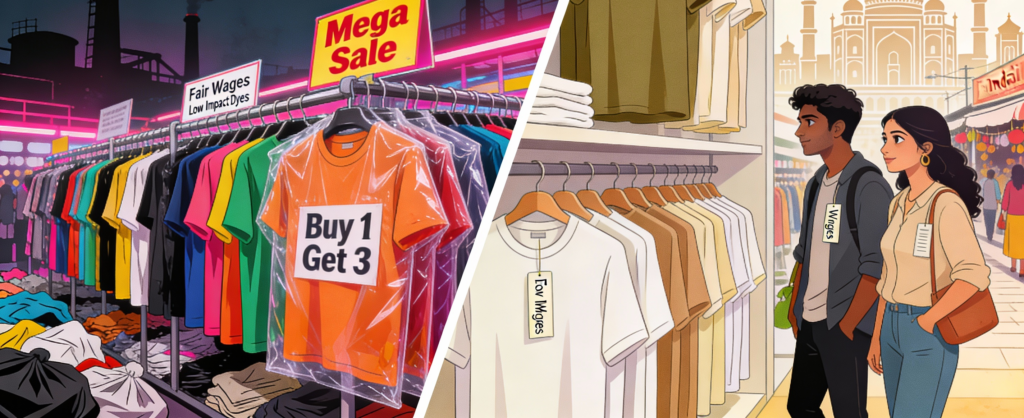
The concept of fast fashion vs. sustainable t-shirts represents the core tension in modern retail. On one side, fast fashion offers trendy, affordable clothing produced at breakneck speed. On the other hand, sustainable fashion promises environmental responsibility, ethical labour practices, and long-term value. For Indian consumers—particularly those in the rising urban middle class—understanding this distinction has become crucial.
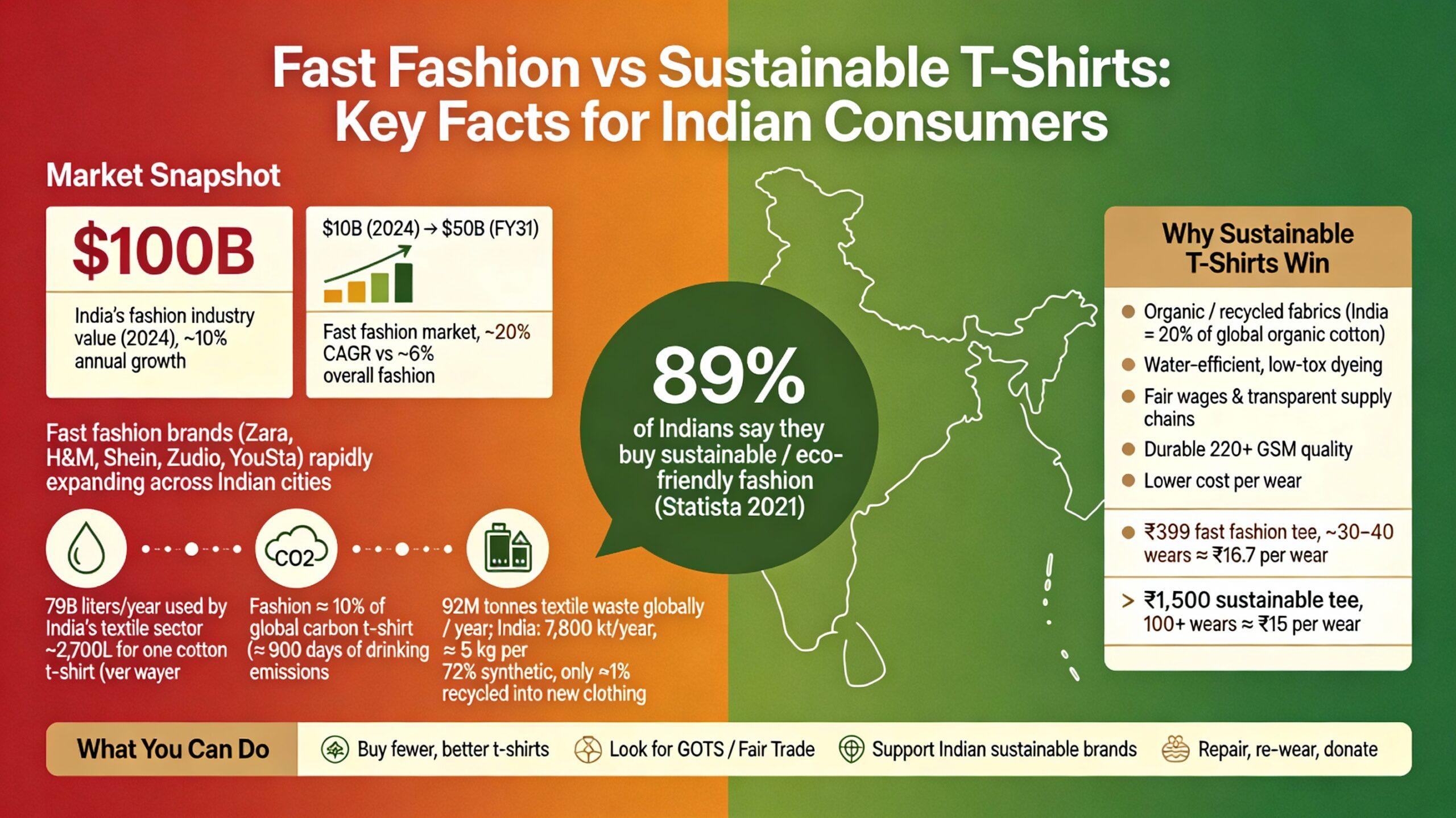
According to a 2021 Statista Consumer Insights survey, 89% of Indians surveyed claimed to buy sustainable and eco-friendly fashion, making Indian consumers the most eco-conscious dressers among all surveyed countries. Yet simultaneously, fast fashion brands like Zara, H&M, Shein, and local players like Zudio and YouSta continue to expand their footprints across Indian cities. This paradox reveals a knowledge gap: many consumers want to make sustainable choices but lack clarity on what truly constitutes sustainable fashion and why the fast fashion vs. sustainable t-shirts debate matters so profoundly.
The Rise of Fast Fashion in India: A Market Phenomenon
Fast Fashion’s Explosive Growth and Consumer Appeal
India’s fast fashion market is experiencing unprecedented growth. In 2024, the fast fashion segment was valued at approximately $10 billion and is projected to reach an astounding $50 billion by FY31, representing a compound annual growth rate (CAGR) of more than 20%—significantly higher than the broader fashion industry’s 6% annual growth rate. This rapid expansion is driven by several converging factors: an aspirational young demographic (nearly 65% of India’s population is under 35), rising disposable incomes, aggressive digital marketing, and the “drop culture” phenomenon where limited collections create artificial urgency.
The appeal of fast fashion vs. sustainable t-shirts from a consumer perspective is straightforward: affordability and variety. A fast fashion t-shirt might cost ₹299-₹699, while a sustainable t-shirt often ranges from ₹999 to ₹2,500 or more. For price-conscious consumers, particularly those from lower-income brackets, this difference is substantial. Fast fashion brands have masterfully leveraged influencer marketing, social media algorithms, and limited-time offerings to create a psychological urgency around fashion consumption.
The Business Model Behind Fast Fashion
The fast fashion business model is built on rapid production cycles. Companies like Shein, for instance, offer approximately 6 million products on their website—a staggering quantity that would be impossible without aggressively compressed design-to-retail timelines. These companies produce new designs every few days, not every season, fundamentally changing consumer expectations.
However, this speed comes at a cost. Consumer behaviour has shifted dramatically: while clothing production has doubled over the past 15 years, the average time consumers wear a particular clothing item has plummeted by 40%. This means people are buying more but wearing less—a clear indicator of the environmental unsustainability embedded in the fast fashion vs. sustainable t-shirts paradigm.
The Environmental Cost of Fast Fashion: Unmasking the Hidden Impact
Water: The Silent Victim of Textile Production
The textile industry is the second-largest consumer of water globally, and India’s textile sector exemplifies this crisis. The Indian textile industry consumes approximately 79 billion litres of water annually. To contextualise this: producing a single cotton t-shirt requires approximately 2,700 litres of water—enough for one person to drink for 900 days.
Moreover, textile dyeing and treatment contribute to 20% of all industrial water pollution in India. In regions like West Bengal’s South 24 Parganas, the situation has become a public health emergency. A 2024 scientific study published in Nature Scientific Reports revealed alarming concentrations of heavy metals—including lead, nickel, and cadmium—in groundwater near textile dyeing clusters. These metals are contaminating drinking water, irrigation systems, and even food crops, with residents reporting widespread health issues, including kidney problems, neurological diseases, and gastrointestinal disorders.
When you choose fast fashion vs. sustainable t-shirts, you’re not just making a style choice—you’re choosing how water is used and polluted in distant parts of India and the world.
Carbon Emissions and Climate Impact
Fashion production accounts for approximately 10% of total global carbon emissions—equivalent to the emissions generated by the entire European Union. This comes from multiple stages: fibre production, transportation, manufacturing, and distribution.
According to research by Quantis International, dyeing and finishing processes alone are responsible for 36% of the industry’s global pollution impacts, with yarn preparation contributing 28% and fibre production 15%. Fast fashion’s entire model—based on rapid shipping, constant restocking, and frequent collection changes—amplifies these emissions.
Textile Waste: A Growing Crisis
Perhaps the most visible impact of the fast fashion vs. sustainable t-shirts choice is waste. Globally, approximately 92 million tonnes of textile waste end up in landfills annually. In India alone, the figure is 7,800 kilotonnes per year—equivalent to about 5 kg of textile waste generated per person.
Alarmingly, only 12-15% of this waste is sent to recycling facilities, and merely 1% of that is actually recycled into new clothing. The remaining waste becomes a burden on landfill systems. Adding to the problem, approximately 72% of India’s textile fabric waste is estimated to be synthetic and non-biodegradable, meaning it will persist in the environment for centuries.
Understanding Sustainable T-Shirts: The Alternative
What Makes a T-Shirt “Sustainable”?
Sustainable t-shirts distinguish themselves across multiple dimensions:
Materials: Sustainable brands prioritise organic cotton, hemp, linen, bamboo, and recycled fabrics. Organic cotton is grown without synthetic pesticides, reducing chemical pollution. India, notably, produces 20% of the world’s organic cotton, positioning it as a key player in sustainable fabric production.
Production Practices: Sustainable manufacturers implement water-efficient dyeing processes, use natural dyes instead of synthetic chemicals, minimise waste through zero-waste cutting techniques, and often employ fair-wage workers in transparent supply chains.
Lifespan and Durability: Sustainable t-shirts are designed to last. Brands emphasise quality construction (often 220+ GSM cotton weight), timeless designs over fleeting trends, and repairability—encouraging consumers to wear garments longer rather than discarding them after a few months.
Leading Sustainable T-Shirt Brands in India
The Indian sustainable fashion ecosystem includes brands like:
No Nasties: Uses 100% organic cotton and is carbon-negative, meaning it actively removes atmospheric carbon dioxide
Anyaah Clothing: Specialises in oversized, unisex t-shirts with social awareness messaging, handmade in India
DVRZI: Focuses on Gen-Z streetwear using eco-friendly fabrics like French terry and cotton fleece
Roar for Good: Creates clothing from recycled PET bottles, bamboo, and organic cotton
Botnia: Offers oversized t-shirts with a focus on sustainable materials
The Terra Tribe: Uses locally manufactured Tencel and handwoven hemp with natural dyes
These brands represent a fundamentally different approach to fast fashion vs. sustainable t-shirts.
Indian Consumer Behaviour: The Knowledge-Action Gap
A Nation of Conscious Consumers
The statistics surrounding Indian consumer intent toward sustainable fashion are impressive. According to a 2021 Statista survey, 89% of Indians surveyed claimed to buy sustainable and eco-friendly fashion products. Furthermore, a 2020 Nielsen survey found that 85% of Indian consumers actively consider sustainability when making purchasing decisions. Additionally, 45% of Indian consumers express willingness to pay a much higher premium for fashion produced fairly and sustainably.
These figures suggest a market primed for sustainable options. However, the actual market data tells a different story.
The Gap Between Intent and Action
While consumer intent toward sustainable fashion is remarkably high, actual purchasing behaviour lags significantly. This “knowledge-action gap” exists for several reasons:
Price Sensitivity: When surveyed about criteria for sustainable fashion purchases, Indian consumers rated quality, price, and comfort as most important, in that order. Only 47% based their purchasing decision on brand or manufacturer values. For many Indians, especially those in tier-2 and tier-3 cities, the price difference between fast fashion and sustainable alternatives remains prohibitive.
Availability and Awareness: Fast fashion brands dominate both online and offline retail channels, with massive marketing budgets. Many Indian consumers remain unaware of sustainable alternatives or don’t know where to find them.
Marketing Greenwashing: Some fast fashion brands claim sustainability without genuine commitment, confusing consumers about the real difference between fast fashion vs. sustainable t-shirts.
The Cost of Choices: Analysing the True Price
What Fast Fashion Actually Costs
A ₹399 fast fashion t-shirt might seem economical, but the true cost extends far beyond the price tag. It includes:
Water depletion in cotton-growing regions
Chemical pollution is affecting millions of Indians
Low wages for garment workers (often ₹5,000-₹8,000 monthly for stitching)
Carbon emissions from rapid shipping
Waste disposal externalities are borne by society
The Value Proposition of Sustainable T-Shirts
A ₹1,500 sustainable t-shirt, by contrast, often includes:
Organic cotton grown with regenerative practices
Fair wages for workers
Minimal waste production
Natural, non-toxic dyes
Durability (often worn 100+ times vs. 30-40 times for fast fashion)
Support for traditional artisan communities
When amortised across the lifespan, a sustainable t-shirt typically costs less per wear.
Why the Difference Matters: Beyond Personal Choice
Environmental Justice
The fast fashion vs. sustainable t-shirts choice is not equitable. Textile pollution disproportionately affects rural and economically disadvantaged communities in India. Children growing up near textile factories in West Bengal, Tamil Nadu, and Gujarat are exposed to toxic groundwater and contaminated food. Meanwhile, affluent urban consumers enjoy trendy clothes without witnessing the environmental devastation.
Supporting Local Economies
Many sustainable Indian brands employ artisans in rural areas, directly supporting traditional crafts and preventing the exodus from villages to overcrowded cities. By choosing sustainable t-shirts, Indian consumers actively support local communities.
Climate Responsibility
With fast fashion’s 10% contribution to global carbon emissions and India’s rapidly growing fashion industry, the collective impact of Indian consumer choices will shape global environmental outcomes. Choosing sustainable options now is an investment in climate stability.
Making the Transition: Practical Guidance for Indian Consumers
Steps Toward More Sustainable Choices
Audit Your Current Wardrobe: Before buying, assess what you already own. Many items go unworn simply because they’re forgotten.
Invest in Quality Over Quantity: Buy fewer, better-made pieces. A ₹1,500 t-shirt worn 100 times costs ₹15 per wear; a ₹500 t-shirt worn 30 times costs ₹16.67 per wear.
Look for Certifications: Certifications like GOTS (Global Organic Textile Standard), Fair Trade, or carbon-neutral labels provide assurance.
Support Indian Sustainable Brands: Brands like No Nasties, Anyaah Clothing, and The Terra Tribe offer quality sustainable options at competitive prices within India.
Extend Garment Life: Repair, alter, and refresh old clothes rather than discarding them. This reduces waste and honours craftsmanship.
Choose Timeless Over Trendy: Trends fade; classics endure. Selecting versatile, neutral-colored t-shirts ensures longer wear.
Conclusion: The Future of Fashion in India
The debate around fast fashion vs. sustainable t-shirts will define India’s fashion industry over the coming decade. Current trends are encouraging: the sustainable fashion sector is growing, with entrepreneurs developing innovative solutions for textile waste, water conservation, and ethical production. Private-public partnerships are increasing, and government initiatives like the Sustainable and Accelerated Adoption of Efficient Textile Technologies (SAATAT) initiative are gaining traction.
However, individual choices matter immensely. When Indian consumers choose fast fashion vs. sustainable t-shirts, they’re voting with their rupees for the future they want to see. A ₹1,500 sustainable t-shirt from an Indian brand represents a choice for clean water in rural India, fair wages for garment workers, and a stable climate.
The statistics are clear: 89% of Indian consumers want sustainable fashion; the market is ready. What’s needed now is action—informed, intentional purchasing decisions that align consumer values with behaviour.
The answer to “fast fashion vs. sustainable t-shirts” is not complicated: sustainable fashion is the only rational choice for Indian consumers who care about their country’s future, their children’s health, and the planet they’ll inherit.